 Meko
Meko
Meko
Meko
A structured route from exclusion to genuine economic participation. Meko acts as your appointed ESD programme manager: we source and vet beneficiaries, diagnose what each one needs, build and run costed development plans, control how funds are applied, and drive beneficiaries towards a formal graduation gate. You approve at every gate; we do the work between them.
The supplier’s journey above the line, your involvement below it, and the single shared outcome at the end.
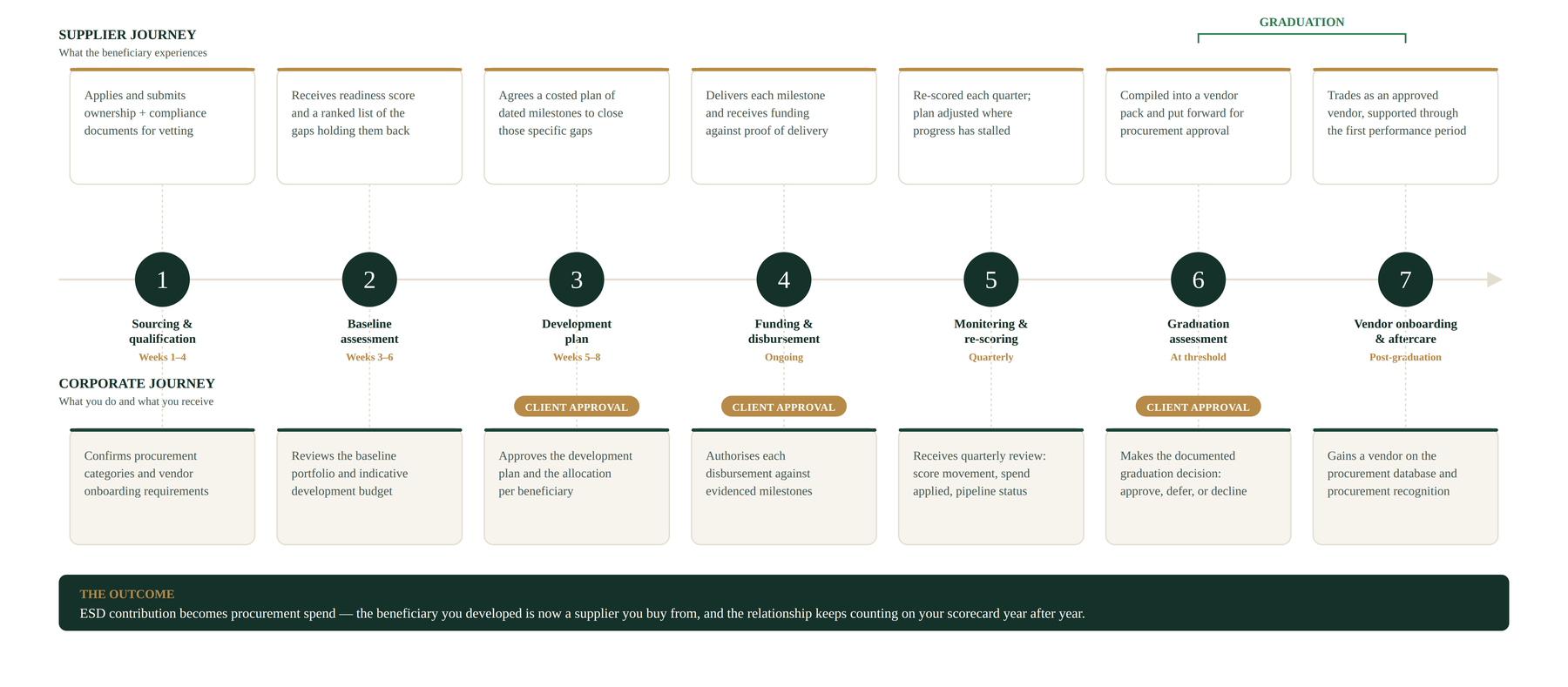
Scroll sideways to view the full lifecycle on a narrow screen.
Each stage has a defined output. Nothing advances — and no funds are applied — without a documented decision from you.
We identify candidate suppliers against your actual procurement categories, then run each through a five-gate assessment covering eligibility, legitimacy and anti-fronting checks, capability, commercial fit, and risk. Candidates who cannot evidence genuine black ownership and operational substance are declined at this stage, not later.
Each qualified beneficiary is scored against three weighted pillars — B-BBEE status, compliance documentation, and fit against your supply chain. The result is a readiness score out of 100 and a ranked list of the specific gaps standing between that business and your vendor database.
The gap register becomes a development plan: a sequence of costed, dated milestones addressing exactly what is blocking the beneficiary. Compliance remediation, certification, systems, equipment, working capital, and capability building are each scoped as separate line items with a defined deliverable.
Funds are applied against approved milestones only. Each disbursement requires a Meko recommendation supported by evidence, followed by your authorisation. Money is released on delivery of the milestone, not in advance of it, and every application is documented against the original plan.
Beneficiaries are re-scored on the same three-pillar model used at baseline. Because the measurement is identical, movement is directly comparable across quarters and across the portfolio. Milestones that slip are escalated, and plans are adjusted where the diagnosis has changed.
When a beneficiary reaches the agreed readiness threshold, they enter a formal graduation assessment against your own vendor onboarding requirements — not against a generic standard. Meko compiles the vendor pack and presents it to your procurement function for a documented decision.
Graduated suppliers are onboarded to your procurement database and monitored through their first trading period. Early-stage vendors fail most often on administration and cash flow rather than capability, so aftercare focuses on those two risks specifically.
Every beneficiary is scored out of 100 against three weighted pillars. The same model is applied at baseline, at each quarterly review, and at the graduation gate — so movement is always directly comparable.
Black ownership percentage, B-BBEE level, entity size classification, and the strength of ownership evidence on file — sworn affidavit or verified certificate.
CIPC registration, SARS tax compliance status, B-BBEE affidavit or certificate, VAT registration where applicable, bank confirmation, and director verification.
Match to your procurement categories, trading history and references, quality certification, and safety compliance including COIDA letter of good standing.
The band determines what happens next. Only “Ready” beneficiaries reach the graduation gate.
Presentable to procurement. Eligible for the graduation gate.
A small number of defined items outstanding. Typically one to two quarters from graduation.
Material gaps in compliance or capability. Active development required.
Fundamental gaps, commonly in ownership evidence or basic compliance. Entry-stage development.
This is the area corporates scrutinise most closely, and correctly so. Meko supports two models. The choice is yours and is fixed in the services agreement.
Your finance function pays the beneficiary or service provider directly. Meko assesses the milestone, compiles the evidence, and issues a disbursement recommendation. You authorise and pay. Meko never takes custody of your funds.
Your contribution is placed into a designated account operated for the programme, and Meko disburses against approved milestones. Suits clients wanting a single administrative point across a multi-beneficiary portfolio.
Under both models, no funds are applied except against an approved milestone, supported by evidence, and authorised by you.
Reporting is built for two audiences with different needs: your verification agency, which requires evidence, and your executive, which requires outcomes. Every report serves both.
Every beneficiary: current readiness score, band, milestone status, and spend applied to date.
Beneficiaries advanced, milestones completed, disbursements made, and issues needing your attention.
Score movement against baseline, milestone completion rates, planned versus actual spend, and the graduation pipeline.
Complete vendor submission: verified compliance documents, capability evidence, references, and Meko’s recommendation.
Evidence pack structured for your B-BBEE verification, including proof of application of funds.
Meko reports contributions made, beneficiary qualification evidence, and the category each contribution falls into. Meko does not issue B-BBEE certificates, does not perform verification, and does not determine your final scorecard outcome — that is determined by your accredited verification agency applying the relevant Codes.
Ninety minutes, at no cost. We work through your procurement categories, your vendor onboarding requirements, and what real transformation would look like in your supply chain.