 Meko
Meko
Meko
Meko
B-BBEE exists to redress an economy that was deliberately built to exclude Black South Africans. A certificate does not do that. Meko runs managed development programmes that move Black-owned businesses into real ownership of supply chains — and keep them there.
Not a transfer of money, but a transfer of capability, access and standing. That takes a programme, not a payment.
B-BBEE is not a corporate courtesy or a reporting obligation that happens to have a social flavour. It is legislated redress for a century of deliberate economic exclusion — land dispossession, job reservation, denial of capital, denial of skills, and denial of ownership. The disadvantage was systemic and it was designed. Undoing it has to be equally deliberate.
Enterprise and Supplier Development is one of the few instruments that can move actual economic participation rather than simply record it. Spend directed at a Black-owned business that never becomes a real supplier has moved money without moving anything else. The certificate is issued; the structure of the economy is unchanged.
The Natives Land Act restricted Black South Africans to a fraction of the country’s land, foreclosing the asset base on which enterprise is normally built. Later legislation extended the exclusion into skills, capital and trade.
The B-BBEE Act made transformation a legal obligation rather than a voluntary gesture, with ownership, skills and enterprise development as its instruments. The Codes set the measure; the intent is structural change.
Ownership and procurement participation still fall far short of the demographics of the country. Compliance activity has grown faster than actual economic inclusion — which is the gap Meko works in.
Redress does not happen by transfer alone. It happens when a business that was locked out acquires the capability, the standing and the access to compete on merit — and when the party holding the door opens it properly. The corporate brings the hand that opens doors. The entrepreneur brings the hand that builds. Held apart, both come away empty: a certificate on one side, a business that stays small on the other.
Procurement spend, contracts, standards, and access to a supply chain that would otherwise stay closed.
The business itself, the risk taken, the people employed, and the roots already in the community.
Both journeys against a single timeline. The supplier develops; you approve, fund and receive. Meko manages the process between them.
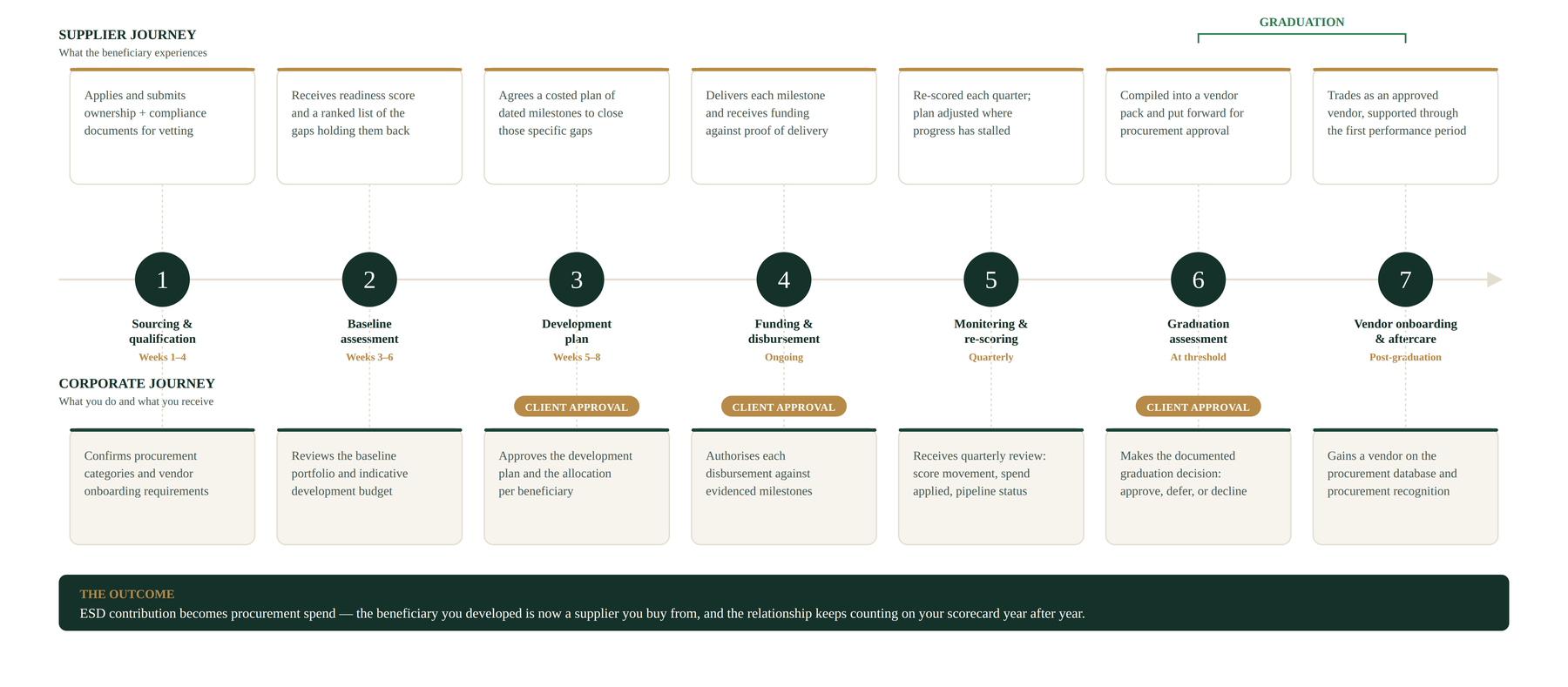
Scroll sideways to view the full lifecycle on a narrow screen.
A beneficiary who never becomes a supplier has changed a number on a scorecard and nothing else. A beneficiary who graduates has entered the economy on different terms — trading on merit, employing people, and holding a position that does not depend on anyone’s goodwill next year.
An owner who employs locally, builds skills locally, and becomes someone the next generation can see themselves in. Economic participation compounds where it lands — that is precisely the outcome the Codes were written to produce.
Not a grant, but a trading relationship. Beneficiaries reach the graduation gate only at a readiness score of 80 or above, sustained across two quarters — so what they hold afterwards is earned and defensible.
ED and SD spend earn points once. A graduated supplier trading with you drives Preferential Procurement recognition year after year — the scorecard follows the transformation rather than substituting for it.
We start with a 90-minute discovery session, at no cost — mapping your procurement categories, your vendor onboarding requirements, and what real transformation would look like in your supply chain.